Cost: Public Transport Usually Wins — But Not Always
For short, solo city trips public transport is almost always cheaper. If a direct metro or tram line runs to your destination and you have no large luggage, loading a transit card and hopping on is the financially smart move. We say this openly rather than hiding it.
The calculation shifts with multiple transfers, toll bridges, or late-night schedules. When travelling as a group the per-person taxi cost can approach transit fares, and with providers that do not add late-night surcharges the gap narrows further.
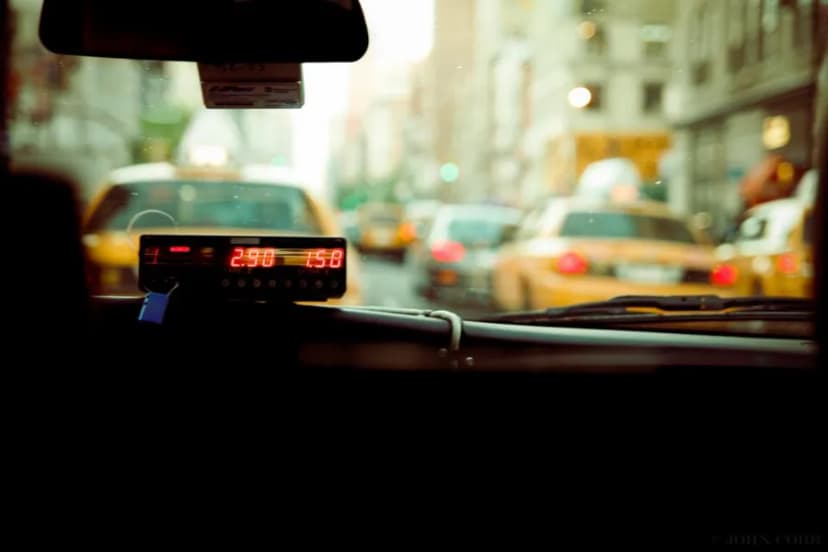
TaksiBul uses a transparent meter for city trips: 180 TL flag fall, then 35 TL per km. For airport and intercity routes a fixed price quote is given upfront with no surprises. Knowing the price before you book makes comparison straightforward.
Journey Time: The Map Can Mislead You
When a navigation app says the metro will take 28 minutes, check whether that estimate fully accounts for transfer walks, waiting times, and crowded station passages. During Istanbul rush hours — roughly 07:30 to 09:30 and 17:30 to 20:00 — actual travel time on the metrobus can be fifty percent longer than the estimate.
Taxis are also affected by traffic; however, you travel door to door. Near major hubs or in certain narrow city-centre streets a taxi can occasionally be slower than rail transit. In those scenarios a metro-plus-last-kilometre-taxi combination is often the most time-efficient solution.
TaksiBul's flight-tracking feature monitors your actual landing time on airport transfers; the driver waits whether your flight is early or late. No public transport alternative offers this.
Comfort and Personal Space
The difference between being squeezed against strangers on a peak-hour bus and sitting in a private, air-conditioned vehicle with your choice of music is difficult to price but can be decisive depending on the purpose of your journey.
If you are heading to a job interview or formal meeting, a demanding rush-hour transit ride can affect your appearance and energy on arrival. For a leisure trip or shopping return the comfort expectation is different.
TaksiBul vehicles are driven by licensed, vetted drivers and maintained to cleanliness standards. Passengers can take calls, rest quietly, or load luggage without negotiation.
Travelling with Luggage: Transit's Weakest Point
Navigating metro staircases or broken escalators with large suitcases is one of the most commonly underestimated challenges in airport travel. Picture a family with two large cases, a carry-on, and a backpack trying to change metro lines during rush hour.
Trams and ferries present similar friction. During busy periods moving comfortably with oversized luggage becomes near-impossible. Left-luggage options exist at some terminals but mean extra cost and time.
TaksiBul airport transfers include full baggage handling in the fixed price. The driver meets you at the terminal, loads your bags, and takes you directly to your address — no detours.

Night Travel: When Services Stop
Istanbul metro and metrobus lines substantially reduce frequency or stop running entirely after midnight. Bus services follow a similar pattern; after 23:00 finding a connection on non-central routes becomes difficult.
If you are planning a late return from an event, restaurant, or the airport, relying on public transport may leave you stranded. Booking in advance is both more comfortable and safer.
TaksiBul operates 24/7. Late-night reservations can be made via the app or WhatsApp. Cash and card are both accepted — payment flexibility matters when you are relying on a service after midnight.
The Learning Curve for Tourists
Istanbul's public transport network is world-class in scale but can be demanding for first-time visitors. Obtaining a transit card, loading credit, learning transfer points, and decoding stop names takes time — time that short-stay tourists often cannot spare.
Language is also a factor. Bus announcements, stop names, and network maps are predominantly in Turkish. Metro lines offer some English announcements but this standard does not extend across the whole network.
TaksiBul supports Turkish, English, Arabic, and Russian. Tourists book in their own language, the driver meets them with a name board, and the fixed price is known before the journey starts. No system knowledge required.
Airport Transfers: Airport Bus vs Private Transfer
Airport buses offer an economical connection between Istanbul Airport and the city centre. For solo travellers outside peak hours these services are reasonable. We acknowledge that openly.
During morning rush or bad weather bus journey times can stretch considerably. With luggage, finding space on a crowded bus is harder. If your hotel lies off the bus route, an additional connection is needed.
TaksiBul airport transfers track your flight, meet you at the arrivals gate with your name on a board, and drive you directly to your address. No bus queue, no taxi rank negotiation, no per-kilometre surprises.
Transfer Fatigue and Stress
Getting most places in a large city by public transport requires multiple transfers. Changing metro lines, boarding a bus, waiting for a tram, and adding walking segments creates cumulative physical and mental fatigue.
This fatigue is hard to measure in isolation. But frequent business travellers and families feel it clearly. Two daily transfers versus a direct journey is a difference that extends beyond minutes on a clock.
For residents who know the system, these routines become second nature. The balance shifts depending on how often you travel, whether you carry luggage, and what time of day you are moving.
Passengers with Reduced Mobility
Transit accessibility has improved in recent years; however, lift breakdowns, crowded platforms, and route gaps still present real obstacles in practice.
Elderly passengers face physical risks from staircases, long waits, and packed vehicles. Pregnant travellers encounter similar challenges.
TaksiBul offers an obvious advantage here: door-to-door service, driver loading assistance, and a calm journey environment. For passengers with mobility limitations a taxi is not just comfort — it is sometimes the only viable option.
Combined Use: Metro + Last-Kilometre Taxi
Treating the two options as complementary rather than competing is the most practical approach in many situations. Covering the main arterials quickly by metro then connecting the final two or three kilometres via TaksiBul can be both fast and cost-effective.
This combination is especially useful when a metro station is still some distance from your actual destination. When you exit the station, open the app and your car can arrive in minutes.
TaksiBul serves last-kilometre requests with no minimum distance requirement. Short trips use the same transparent pricing as longer ones.
When to Choose Which: An Honest Summary
Public transport makes sense for: short to medium solo city trips without large luggage, when you know the route, when time flexibility exists, and during heavy traffic on well-served rail lines. For daily commutes it is economical and environmentally responsible.
Taxi makes sense for: airport and station transfers, travelling with large luggage, late-night returns, group trips, tourists unfamiliar with the network, time-sensitive journeys, passengers with mobility needs, and any time door-to-door comfort without stress is the priority.
You do not need to know the city's transport network to use TaksiBul. Download the app or reach us on WhatsApp for instant access to licensed, fixed-price, 24/7 taxi and transfer service.